Text size
DefenseNewsGlobal Security.
Strategic Insight.
Breaking News

European drone builders tinker with AI in navigation and targeting

MILAN: Drawing from Ukraine’s battlefield successes, a growing number of European companies have begun fielding drones with artificial intelligence features.

drones, AI, navigation, targeting, autonomy, EdgeAI, swarm, Europe, defence, startups, interception, encryption, GNSS-denied, innovation, AI-WASP,europe,Ukraine,United State,United States,

An element of Ukraine’s recent “Spider Web” operation on June 1 – a covert drone attack carried out deep inside Russia – was largely overlooked: the supporting role played by AI.

According to the Center for Strategic and International studies, AI-driven tools were likely critical in training the software of explosive, first-person-view drones. These tools enabled the drones to spot threats, indicate possible strike points for each one, and guide them to targets if the connection with the operator went astray.

The mix of drones and AI is now becoming more prevalent in new designs proposed by manufacturers.

At a recent Drone Summit held in Estonia, a handful of Latvian drone companies showcased their current focus of AI-targeting capabilities. Among them, Origin Robotics recently launched an autonomous drone interceptor created to destroy adversarial unmanned aerial vehicles.

Dubbed “Blaze,” the craft was trained with the help of AI to differentiate between various aircraft types and other objects. Once the system locks onto a target, it takes off and dashes to intercept it by smashing its warhead into it.

Last month, Finnish company Patria announced it will lead a European industry consortium for the new joint Artificial Intelligence Warfare Adaptive Swarm Platform, or AI-WASP.

The program, which includes Finland, Sweden, Estonia, Italy, Greece and Spain, seeks to develop AI-controlled software for use on small to medium-sized unmanned and manned systems.

The project recently received €45 million ($53 million) in funding from the European Commission.

Another company making headway into this space is the Czech manufacturer LPP Holding, which said in May that it provided AI-guided drones to Ukrainian forces. The company’s MTS drones are equipped with AI-based visual navigation specifically designed for GPS-denied areas, per the company website.

While the European defense industry is progressively making greater use of AI in unmanned systems, experts say there remain challenges in its integration, especially when it comes to onboard information.

“The issue is data – what kind of information is used to train UAVs to fly to a certain location or strike specific targets?” said Samuel Bendett, an advisor at the Centre for Naval Analyses. In a targeting sequence, data resident on the drone – versus linked up through an external transmission – would be the sole basis for strike decisions, a challenge in rapidly changing battlefield conditions, he added.

drones, AI, navigation, targeting, autonomy, EdgeAI, swarm, Europe, defence, startups, interception, encryption, GNSS-denied, innovation, AI-WASP,europe,Ukraine,United State,United States,

A recent report by the U.S.-based Center for Strategic and International Studies found that Ukraine has opted to train small AI models on small datasets instead of creating large, broad templates.

“This approach enables fast and efficient onboard processing on the limited computing power of small and inexpensive chips, which can be quickly updated and retrained … these datasets can be collected through a company’s battlefield operations or open-source data from social media,” the report said.

Germany-based drone manufacturer Quantum Systems unveiled recently the Mosaic UXS, a software command-and-control platform for unmanned systems to unify capabilities across air, land and sea domains.

The company reports that it is capable of mission planning and execution with machine learning and can plan swarm operations in which each drone is tasked with completing an individual mission.

Ukrainian defense companies have focused on similar endeavors by developing standalone AI software and compact chips that can be fused on a wide range of platforms from FPV drones to turrets set up on unmanned ground vehicles.

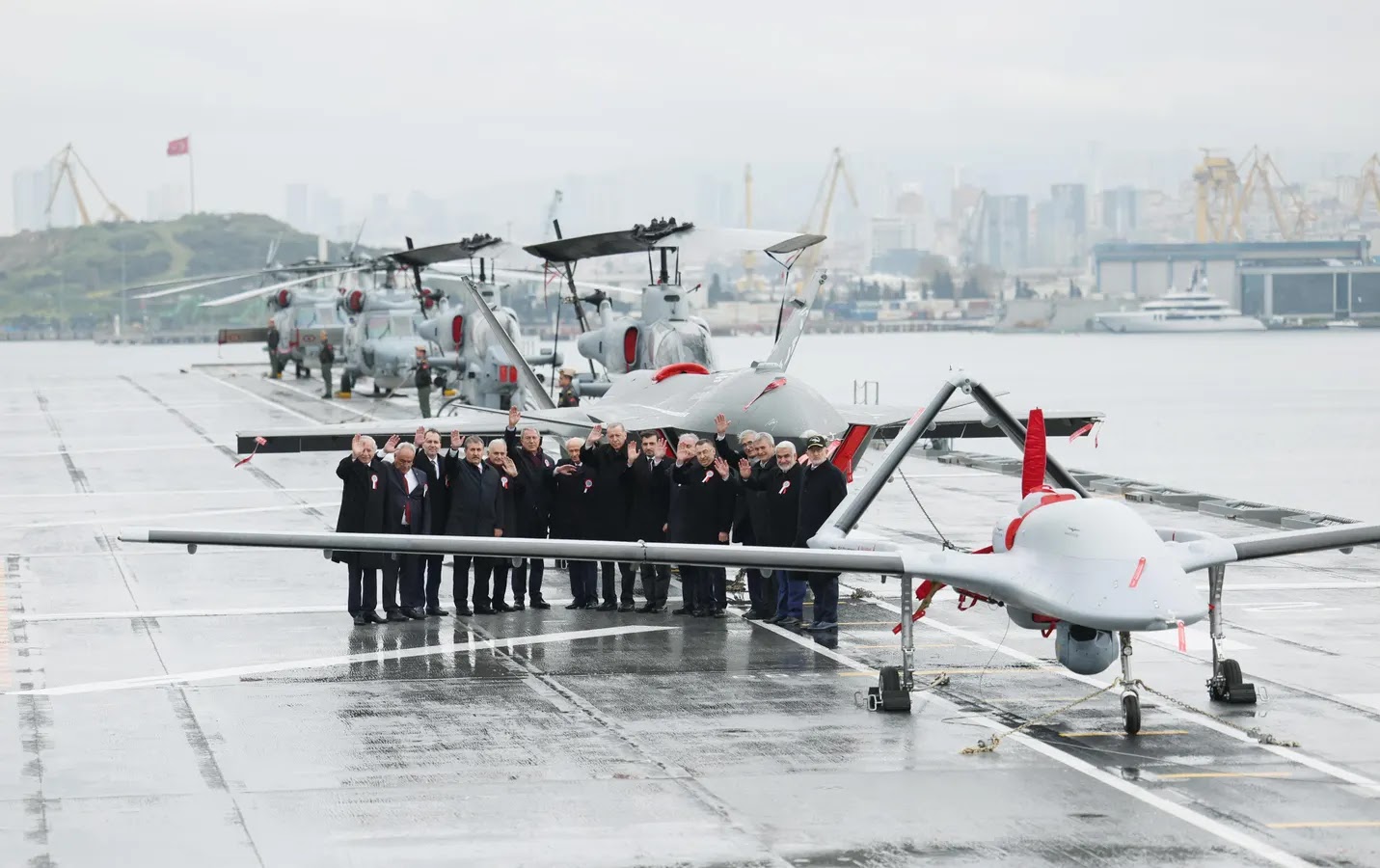
Turkey's Drone Milestone: Successful Aircraft Carrier Takeoff and Landing Marks Historic Feat for Bayraktar Kızılelma Strike UAV

DefenseNews: Turkey has achieved a significant milestone in its defense technology with the Bayraktar Kızılelma, an advanced unmanned combat aerial vehicle (UCAV), successfully completing its first takeoff and landing on the TCG Anadolu, the country's largest warship. This groundbreaking achievement signifies Turkey's commitment to integrating cutting-edge drone capabilities into its naval operations, further enhancing its strategic autonomy in military aviation.

Drones, Technology, Defense, Innovation, Carrier, UAVs, Turkey Navy, Bayraktar, Combat

A Game-Changing Development

The Bayraktar Kızılelma's successful carrier-based operations are a testament to the rapid advancements in Turkey’s indigenous drone technology. Manufactured by Baykar, a leader in UAV production, the Kızılelma marks a new era of combat-ready drones capable of operating from short-runway ships, a feat previously dominated by manned aircraft.

The TCG Anadolu, initially designed to support short takeoff and vertical landing (STOVL) aircraft like the F-35B, was repurposed to serve as a drone carrier after Turkey's exclusion from the F-35 program. This adaptation enables the vessel to deploy various UAVs for missions ranging from reconnaissance to precision strikes, offering unparalleled versatility in naval warfare.

The Technical Feats of Kızılelma

The Bayraktar Kızılelma is designed for carrier-based operations with a focus on maneuverability, endurance, and advanced combat capabilities. Key features include:

  • Short-Runway Compatibility: Its design allows for seamless operations on ships like the TCG Anadolu, which lack the catapult systems typically required for fixed-wing aircraft.
  • High Payload Capacity: The UAV can carry advanced munitions, making it suitable for diverse mission profiles, including close air support and air-to-ground strikes.
  • Stealth and Autonomy: Equipped with low observability features and AI-driven systems, the Kızılelma is built to operate in contested environments.

The drone is powered by an advanced turbofan engine, offering extended flight endurance and operational altitude, further solidifying its role in Turkey's strategic defense arsenal.

Drones, Technology, Defense, Innovation, Carrier, UAVs, Turkey Navy, Bayraktar, Combat
Implications for Naval Power

This innovation transforms the TCG Anadolu into a versatile drone carrier capable of hosting multiple UAVs, including the Kızılelma and the Bayraktar TB3. By deploying drones from naval platforms, Turkey significantly expands its operational reach, particularly in contested maritime zones like the Mediterranean and the Black Sea.

The integration of UAVs offers several advantages:

  1. Cost Efficiency: Compared to traditional manned aircraft, drones like the Kızılelma are more economical, reducing both operational costs and risks to human pilots.
  2. Mission Flexibility: With capabilities ranging from intelligence gathering to targeted strikes, these drones provide tactical superiority in diverse scenarios.
  3. Enhanced Surveillance: Equipped with state-of-the-art sensors, UAVs offer real-time intelligence, ensuring rapid decision-making in dynamic combat situations.

Challenges and Future Prospects

While the Kızılelma’s maiden carrier operation is a landmark achievement, challenges remain. The development of robust command-and-control systems to manage simultaneous drone operations is critical. Additionally, further advancements in drone swarm technology and AI integration will be pivotal in maintaining Turkey's edge in UAV technology.

Baykar’s continued innovation is evident in its plans to develop larger, more capable drones, such as the Bayraktar TB3, which will complement the Kızılelma in carrier-based missions. These developments underline Turkey’s ambition to become a global leader in unmanned aerial combat systems.

Strategic Impact on Global Defense

Turkey’s success with the Bayraktar Kızılelma signals a broader shift in military aviation, where drones are increasingly replacing manned platforms. This achievement positions Turkey alongside nations like the United States and China, which are also advancing carrier-based UAV programs.

As geopolitical tensions rise, particularly in regions like the Eastern Mediterranean, the ability to project power through drones offers a significant strategic advantage. The Kızılelma's deployment showcases Turkey’s resolve to safeguard its interests while contributing to NATO’s collective defense capabilities.

Conclusion

The Bayraktar Kızılelma’s first carrier-based operation marks a historic milestone for Turkey, reflecting its growing expertise in defense innovation. This achievement not only enhances Turkey's naval capabilities but also sets a benchmark for the future of UAV technology in modern warfare. With continuous advancements, Turkey is poised to shape the next generation of unmanned combat systems, cementing its role as a global defense leader.

Send us a message

Story tips, corrections, questions or advertising enquiries: fill in the form and our team will reply by e-mail.

Newsletter

Stay Updated with Defense News

Get breaking defense and security news, analysis and exclusive reports delivered straight to your inbox.

Contact the newsroom

Have a defense story or an update to report?

Send us a news tip, a correction or a press release. Every message is read by our desk.